A Sunday Surprise: Two Hours, Endless Magic on the Farm Flats - Nov 30, 2025
- Jennifer Dowd

- Nov 30, 2025
- 5 min read

I didn’t intend to photograph today. Not on a Sunday.
My only goal was simple: take Finnegan out for a walk and continue his little adventure-cat training. Fresh air, sunshine, and a gentle stroll—nothing more.
But, before the walk, I felt a tug. A tiny nudge. Go check the farm flats.
And thank goodness I listened, because what unfolded over the next two hours was pure wildlife magic.
The sun was blindingly bright—one of those winter days where everything feels washed in white and gold. I spotted a silhouette perched at the top of a bare tree and for a moment thought, Oh! A kestrel! But the camera corrected me. A Northern Flicker.
My mind softened, my breath slowed, and the longer I watched him, the more the details revealed themselves. The colors. The patterns. The gentle way he shifted his weight on the branch. The way the sunlight hit those warm chestnut tones.
This is what I love most about birding—how a single moment with a single bird can quiet the mind faster than meditation. When the world drops away, you start to notice the tiny threads that make these creatures so extraordinary.

Did You Know?
Northern Flickers are one of the only woodpeckers that prefer feeding on the ground, which is why they’re often seen perched high, scanning their surroundings like woodland sentinels.
I drove a bit further and pulled over for what I thought were “just small birds on a fence.”
Nope.
Dark-eyed Juncos—right where I parked—feasting like it was brunch rush. They gave me the most adorable over-the-shoulder looks, crumbs and seeds stuck to their beaks, as if to say: Yes, we see you. We’re eating. Their attitude was perfection.

Dark-eyed Juncos often appear round, fluffy, and adorably plump, especially in the colder months. But it’s not body fat—it’s feather puffing. They trap warm air between their feathers to insulate themselves, turning into perfect little feathered marshmallows. This is a survival strategy that keeps them warm during chilly mornings on the farm flats.
Did You Know?
A Dark-eyed Junco weighs about the same as two tablespoons of sugar—yet they migrate hundreds of kilometers each year.

As the fields opened up in front of me, I realized I had hit the birding jackpot.
Killdeer everywhere. Mallards too.

At first, you could barely see anyone at all—just little shapes blending into fall stubble and soil. But the unmistakable kill-deer! kill-deer! betrayed them.
So I sat. Waited. Let them come into the moment.
When I reviewed the portraits… they were looking right at me. Not startled—just aware.
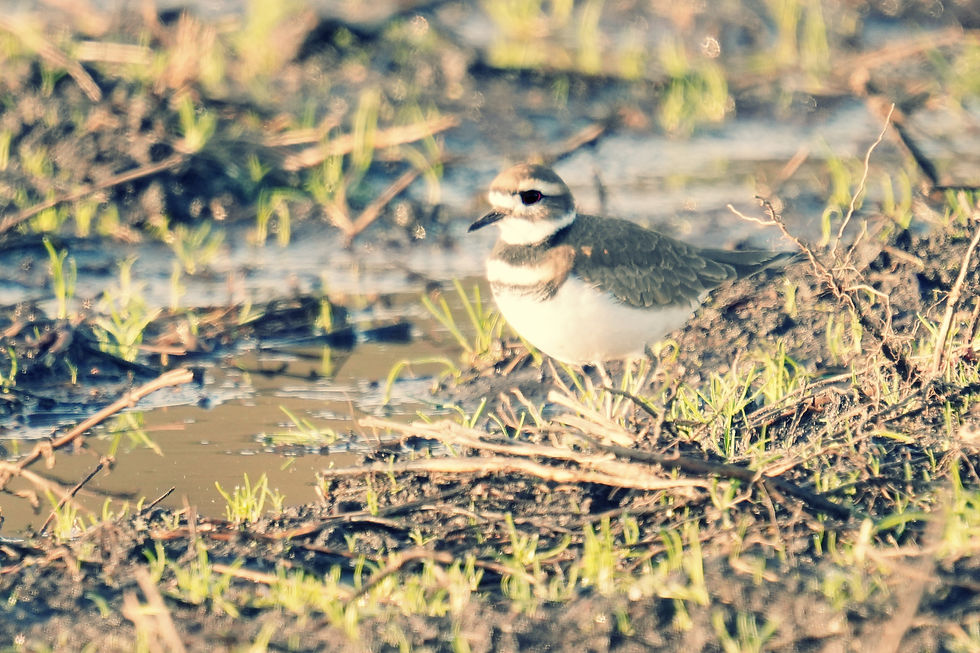
Did You Know?
The orange wash you sometimes see on a Killdeer’s back isn’t just beautiful—it’s strategic. Their plumage changes subtly with the seasons, helping them disappear into autumn landscapes filled with brown grasses and orange-tinged vegetation. When you’re a ground-nesting bird, camouflage is everything.

A little farther down the road, a soft movement in a muddy farmer’s field caught my eye—an entire flock of Greater White-fronted Geese scattered like brushstrokes across the landscape.
So I stopped. And simply observed. Finnegan was very interested as well.

They were completely at ease, picking through the wet earth for bugs and grubs, sun on their feathers, moving together with that effortless flock rhythm that only birds seem to understand. They kept a casual eye on me—aware but unbothered—and continued living their quiet, beautiful goose lives right in the middle of a busy farm area.

It struck me how natural and peaceful they were in a place so filled with human activity.A reminder that wildlife adapts, persists, and carves out moments of stillness even when the world swirls around them.
And the colours—oh my goodness. Layers of brown on brown on white, topped with that unexpected burst of orange on their legs and bills. Like a painter chose a simple palette but used it masterfully. Absolutely incredible.

They were teaching me that I don't need perfect conditions to find peace. You can root yourself anywhere—mud, noise, chaos—and still find warmth, community, and calm. Just like these geese.

Just as I was about to move on, a flutter overhead. Hundreds of blackbirds—like confetti tossed across telephone wires.

And tucked among them… a male American Kestrel.

He was tiny, adorable, skittish, and perched himself in shadow just to make things difficult. But even a few seconds of kestrel energy is a gift.
I hit another part of the flats and found hundreds of Canada Geese with a few Snow Geese mixed in like winter ornaments. Then, two surprising shapes high in the trees. Two bald eagles, sunbathing. One was panting—something I had never seen! Birds do this to cool themselves, similar to dogs.
Watching that eagle pant in the heat—this symbol of strength, freedom, and power—was a reminder that rest is not weakness. Even the mighty pause. Even the fierce cool themselves, slow down, and take what they need.
The message I was getting, take breaks without guilt. Rest is part of resilience.

They didn’t stay long. Chaos to cause of course and wouldn't you know it, as soon as they left, hundred's of geese took to the sky. It was amazing.

I kept driving and finally found a closer swan group, this time accompanied by two more bald eagles keeping watch like silent guardians.

A little farther down the flats, I finally found a group of Trumpeter Swans much closer to the road—close enough to observe, but far enough away that I didn’t risk disturbing them. So I stayed in my car, windows down, camera ready, and simply watched.

These swans are here on their annual migration, stopping over in our farmlands to refuel before continuing their long journey south. Trumpeters need massive amounts of energy, and fall agricultural fields offer exactly what they crave: spilled grain, leftover potatoes, roots, shoots, and nutrient-rich stubble left behind after harvest. It’s a seasonal buffet, and the birds know it well.
Their behaviour tells you everything—this land is essential to them.


From the safety of my car, I watched their little world unfold:
— some flew overhead in small family groups, their wings slicing the sky with heavy grace,
— some landed with those comically awkward skids across the shallow pond,
— some practiced their stretching routines—swans really do have “yoga pose” energy,
— some slept delicately with their necks curled into perfect white commas,
— some waddled, muttered, and gently nudged each other like old friends catching up after a long journey.


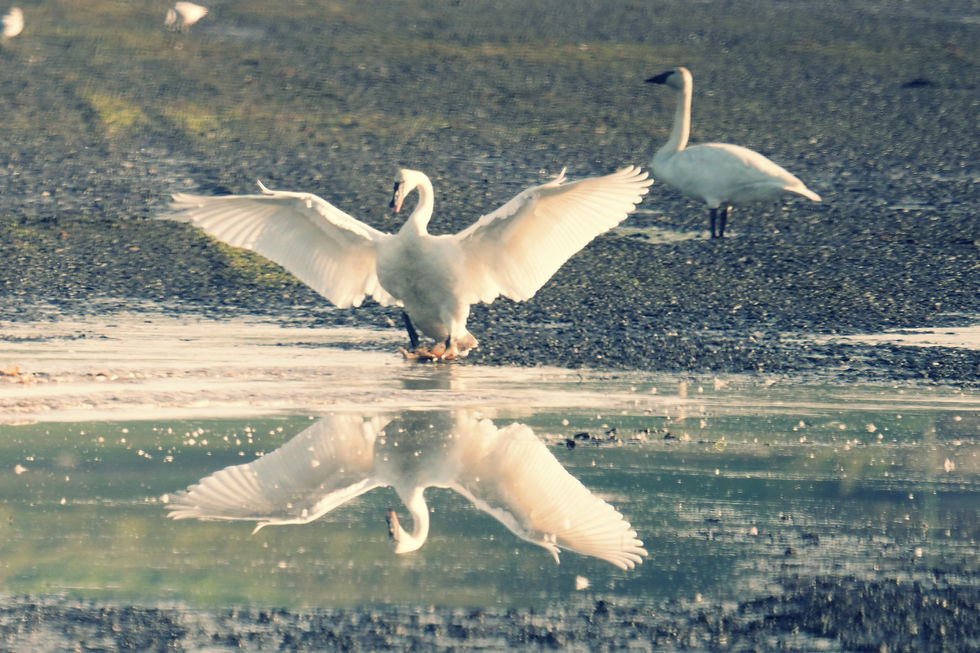

The trumpeting…
It fills your whole chest.
A sound both ancient and grounding.

And all of this—this migration stop, this feeding ground, this moment of rest and renewal—was happening in the middle of an urban city. Fall farmlands are true wildlife meccas, sanctuaries disguised as ordinary fields.

You don’t have to go far. Sometimes all you need is a car, some patience, and an open heart.
On the way to grab an iced coffee, I caught sight of a raptor perched on a telephone pole—quiet, composed, surveying her world with absolute confidence. A Broad-winged Hawk.

Up close, she was breathtaking.
Mottled in soft browns and whites, feathers patterned like forest shadows, and those eyes—dark, focused, framed in what looked like perfect natural eyeliner. A wild queen with a winged crown.

She wasn’t hunting.
She wasn’t bothered.
She was simply living—coexisting in harmony with everything around her. Cars, farms, roads, humans… and still entirely, unapologetically herself.
I used the car-as-your-blind method and she allowed me to get surprisingly close. She watched me with curiosity more than caution before hopping gracefully to another pole, giving me one more moment before continuing her day.

Just wonderful. Another reminder that even in busy, human-filled landscapes, wildlife finds ways to thrive, observe, adapt, and simply be.
Today felt like a spiritual nudge wrapped in feathers. Birds teach us presence. They teach us patience.
They teach us to drop expectations and just be. And it only took two hours. Two hours of being open, being curious, and being alive to the world around me.


What a profusion of different birds. You hit the jackpot. Good going!
Yu just never know what's going to turn up.