Bee Art for Conservation: Small Actions Can Make a Difference - Aug 21, 2026
- Jennifer Dowd

- 2 days ago
- 4 min read

Earlier this summer, I set out to try something a little different: bring art and conservation together to raise funds and awareness for British Columbia's native bees.
The result was the Bee Art for Conservation Project, created in support of the Native Bee Society of BC.

Over two weeks, we were incredibly fortunate to have the exhibition hosted at the beautiful HCP Gardens in Saanich. Nine artists contributed bee-inspired artwork in a wonderful variety of mediums, including watercolour, painting and photography. One of my favourite parts of the entire project was seeing how differently each artist interpreted the same source of inspiration. Native bees became photographs, delicate watercolours, colourful paintings and completely different artistic expressions.
It was a lovely reminder that nature doesn't just need our protection, it inspires us, too.

From the beginning, I wanted the project to be about more than displaying and selling artwork. I wanted people to leave knowing something they hadn't known before about native bees.
In the weeks leading up to the exhibition, I spent a lot of time building three different types of bee nests, trying to make each one as close to reality as I could. I wanted to show visitors something that many people don't realize: not all bees live in hives.

Different native bee species nest in different places and depend on different habitat features to survive. The nests, along with the other educational materials in the exhibit, gave us an opportunity to introduce people to a side of bees they may never have encountered before.

One of the most rewarding moments actually happened while I was setting up and taking down the exhibit. People walking through the gardens would stop to look. They asked questions, examined the displays and commented on how interesting and informative the educational materials were.
Those interactions mattered to me because fundraising was only one measure of whether the project was worthwhile. Getting someone to stop, look at a bee differently and perhaps understand a little more about what it needs is another.

British Columbia is home to an incredible diversity of native bees, but there is still so much we don't know about them.
That lack of information matters.
The Native Bee Society of BC works to catalogue and study bees throughout the province. By collecting data and learning which species are present and where they occur, we can better understand the habitats and environmental conditions they need to survive.
We can't effectively protect species when we don't know enough about them.
Bees are also an essential part of the ecosystems we depend on. They pollinate plants, support biodiversity and contribute to the functioning of healthy ecosystems. Protecting bees isn't simply about protecting an individual insect. It's about protecting the much larger web of life that depends on them, including us.


That was why I wanted the funds from this project to support the Native Bee Society of BC's work.
So, Was It Successful?
In total, the Bee Art for Conservation Project raised $743.
I'll admit that I have mixed feelings about that number.
When I started this project, I hoped we might raise a few thousand dollars. We didn't.
But summer can be a difficult time for fundraising. People are travelling, many are away, and with the financial pressures people are facing right now, there simply isn't as much money available to give.
So I've had to ask myself a different question.
Does raising less than I hoped mean I shouldn't have tried?
Absolutely not.
The Native Bee Society of BC has $743 more to put toward its conservation work than it did before this project. Nine artists used their talents to celebrate native bees. People stopped in the gardens and learned something new. Conversations happened. Awareness was raised. And for two weeks, native bees had an exhibit dedicated to showing people why they are fascinating and worth protecting.


That's not nothing.
In conservation, it can be easy to feel as though our individual efforts are too small to matter. The problems are enormous, and most of us don't have thousands of dollars to donate or the ability to devote our entire lives to solving them.
But change doesn't only come from enormous actions.
Small actions, repeated over time and taken by many people, can make a difference.
This project was one of mine.

I wanted to contribute to native bee conservation in a way that used the skills and resources I had available to me. I brought together artists, conservation and education and tried something I hadn't done before.
Did I raise thousands of dollars? No.
Did I make a contribution? I think I did. And I'm content with that.

To the nine artists who trusted this little project with their work, to HCP Gardens for giving us a beautiful place to share it, to everyone who stopped to look and learn, and especially to everyone who purchased artwork or contributed to the fundraiser: thank you.
Together, we raised $743 for native bee conservation in British Columbia.
And that's $743 worth of difference that wasn't there before.
A Little Unexpected Conservation on the Side
As I was packing up the exhibit, the day decided to give me one last wildlife encounter.
With temperatures over 30°C, I happened to turn around and spot a juvenile hummingbird fledgling lying on the hot cement. The poor little guy appeared to be overheated and exhausted, so I moved him somewhere safe and gave him a quiet place to rest on one of my displays while I continued packing everything up.
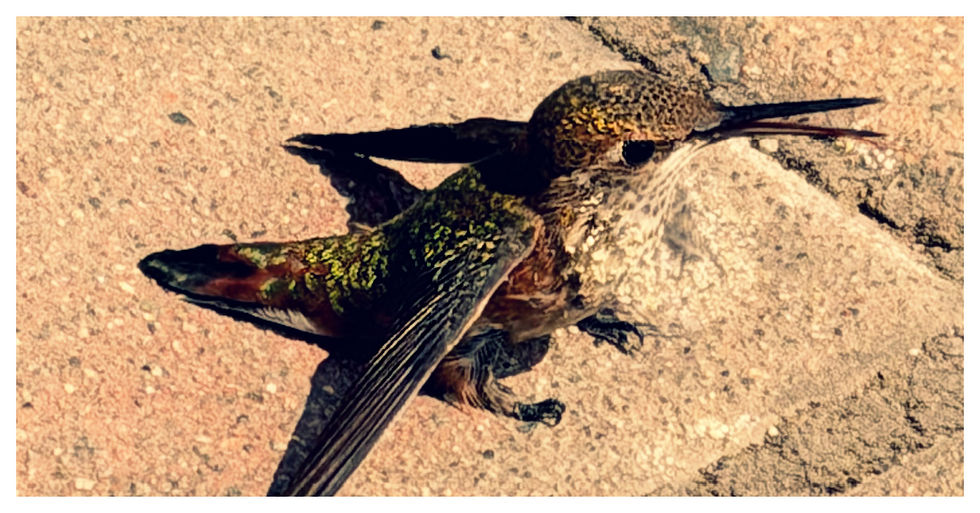
After a little time to recover, he suddenly took off, flying away with an enthusiastic tweet, tweet, tweet.
I'm choosing to interpret that as "thank you."
He was incredibly lucky that I happened to turn around when I did — and it felt like a rather fitting way to end two weeks devoted to conservation.

I'm not saying I'm a Disney princess.
But I'm also not saying I'm not. 😂


This is such important and valued work! Bees deserve more recognition than they get!
I like and appreciate bees and this serves to teach people that they matter to us all.