Bunnies, Swallows, Ladybugs, and Ospreys – Lessons from a Summer Morning - Aug 9, 2025
- Jennifer Dowd

- Aug 9, 2025
- 6 min read

Lately, the weight of my grief has felt especially heavy.
It’s the kind that creeps in quietly, sits in your chest, and makes the days blur together. This morning, I decided I needed to break that cycle. I needed to move, to seek out life, and to let nature remind me of its rhythms the systems it’s been perfecting for millions of years. So I packed my camera, tucked my kitten Finnegan into his new travel backpack, and set out for a morning adventure.

My plan was simple: photograph ladybugs before the heat woke them and give Finnegan a gentle introduction to the sights and sounds of the world beyond our home. But as I’m learning, nature has its own system of events — one I’m slowly learning to trust.
Before I even reached my first destination, construction forced me onto a detour. First lesson of the day: sometimes the detours bring the magic.
A wild bunny appeared, enjoying its morning breakfast. It moved toward me, then stopped just close enough for me to stay in the car and capture its portrait with my 600mm lens.

Did You Know?
Wild rabbits are most active during the early morning and late evening hours — a behavior known as crepuscular activity. This timing helps them avoid predators and the heat of the day. They have nearly 360-degree vision, allowing them to spot danger without turning their heads, but they can’t see directly in front of their noses! Instead, they rely on their sensitive whiskers and keen sense of smell to explore and forage.

The bunny was cautious yet present, reminding me of the balance between awareness and trust. I thanked it silently and moved on.
A Eurasian Collared-Dove perched high on a telephone wire caught my eye next. I hopped out, snapped a few shots, and felt my energy shift. I could feel myself tuning into the morning’s flow.

Then came the swallows.
For weeks, I’d wanted to photograph the ones near a nearby farm field. Today, they were everywhere — darting through the air, circling wires, and filling the sky with their playful energy.

Did You Know?
Barn swallows are the most widespread species of swallow in the world, found on every continent except Antarctica. Their distinctive long, forked tails and agile flight make them incredible aerial hunters they can catch and eat insects mid-air without ever landing. Barn swallows migrate thousands of miles each year, with some North American populations traveling all the way to South America for the winter. Young fledglings often practice short flights and playful chases, building the skills they’ll need for these epic migrations.

Photographing them in flight was impossible; they were too fast, too precise, working in perfect coordination. I settled for portraits of them soaking up the sun.

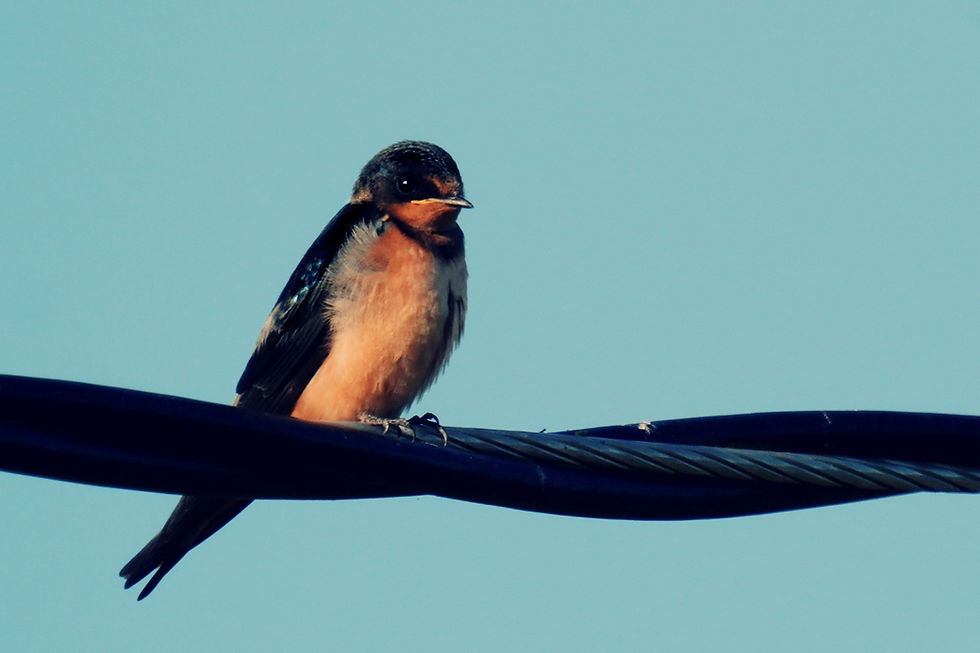
Burnt orange chests, metallic blue feathers, and lively eyes. Many were fledglings, feathers still a bit untidy. They dive-bombed each other, called out in bursts, and played in the air like children — all while the adults sat calmly nearby, eyes half-closed, trusting their young to learn through experience.

Fun Fact:
When young barn swallows dive-bomb each other, it’s more than play — it’s practice. These aerial games help fledglings fine-tune their flight control, speed, and coordination so they’re ready for long migrations and fast insect hunting.
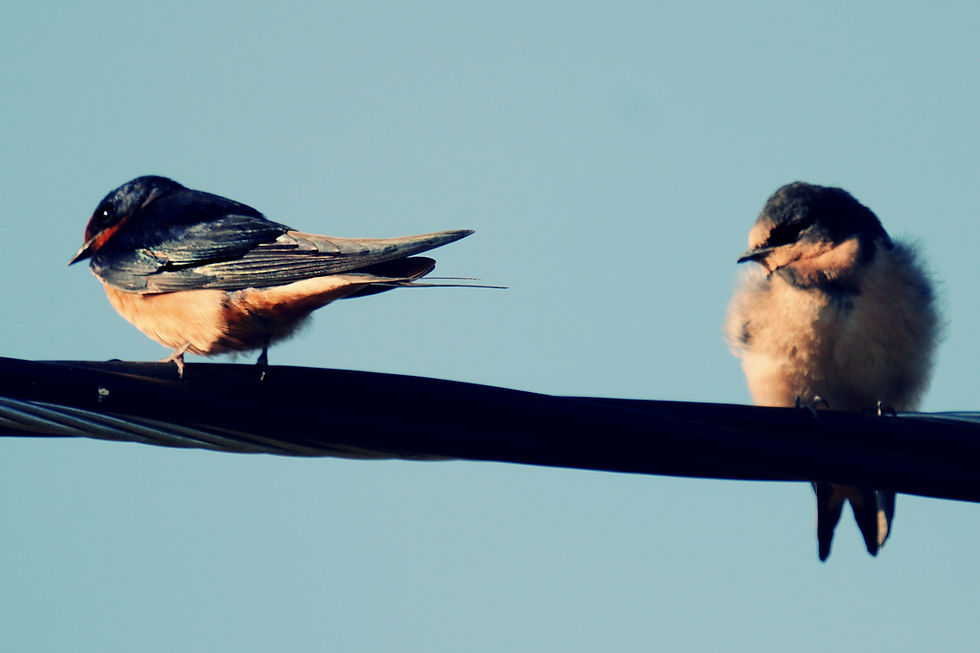
From them, I learned about community — how each bird plays its part in the system. The young test their limits, the elders hold space, and somehow, it all works.
A sparrow was next, giving me a comical reminder of how often wildlife surprises me. My first shot was nothing but its backside, and I muttered how nice it would be to get a face shot. As if on cue, it turned toward me (look at that sass!) before flying off. I laughed and thanked it for the moment.

At last, I reached the ladybugs.

Finnegan was calm, curious, and quiet — a little observer in his carrier. I photographed the ladybugs with my 100–600mm lens (birds may have my heart, but tiny beetles hold their own magic).
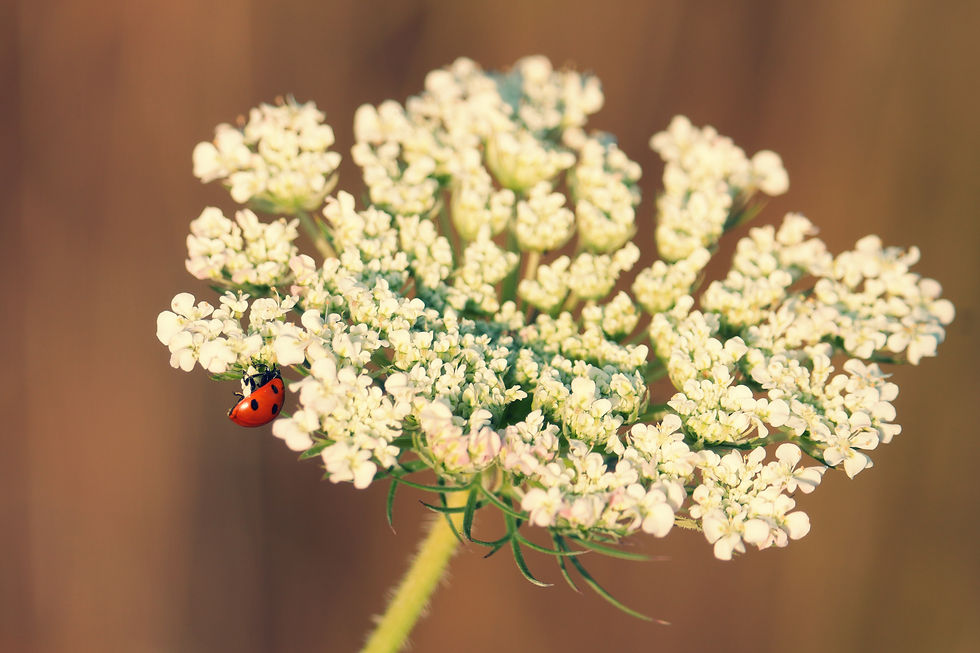
Fun Fact: When threatened, ladybugs can “play dead” and release a yellow, foul-smelling fluid from their legs to deter predators — a defense trick called reflex bleeding.

Did You Know?
Ladybugs, or lady beetles, are nature’s tiny pest control experts — a single ladybug can eat up to 5,000 aphids in its lifetime. Their bright red or orange coloring isn’t just pretty; it’s a warning signal to predators that they taste bad and may even be toxic.

The ladybugs worked with quiet purpose, unbothered by my presence. Their system is one of steady, persistent care — moving from leaf to leaf, tending to their world without hurry. Is there a lesson in that?
As if to reward me for slowing down, a northern flicker and a small golden-capped sparrow appeared, foraging in the grass. Each species has its own system of survival — the flicker probing for insects, the sparrow searching for seeds — both fulfilling their role in the larger whole.


After an iced coffee for me and a pup cup for Finnegan, we stopped by a marina to see if the herons had fledged. That’s when I noticed a silhouette high in a nesting tree. My heart skipped, a juvenile eagle, maybe? I parked, grabbed my camera, and felt the rush of recognition.
It was an osprey!!!!
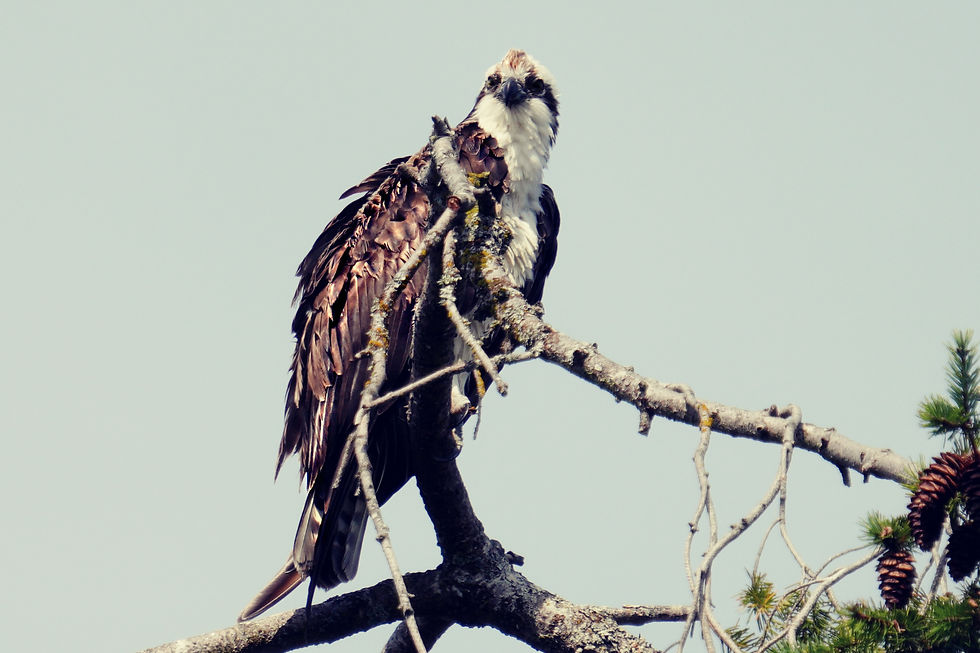
Perched in the morning light, preening, fully aware of its position in the sky’s hierarchy, the osprey radiated strength. The moment I spotted him, electricity shot through my body, I had never photographed an osprey perched like this before. His white-and-brown coloring reminded me of an Oreo cookie, a striking contrast against the blue sky.

He seemed completely unbothered by the world around him. From his high vantage point, he supervised his juveniles’ short flights from the nest, occasionally glancing their way but mostly focused on his own preening and soaking up the warmth of the sun. The sheer power and self-possession in his stance was breathtaking. He looked like a master of his domain, strong, steady, and utterly in control.
Fun Fact:
Ospreys are unique among raptors because they can reverse one of their outer toes, giving them two toes in front and two in back, the perfect grip for carrying fish head-first, which makes them more aerodynamic during flight.
I spotted its nest and watched as two juveniles practiced short flights, their calls echoing across the marina. Their system was one of training, building strength, testing skill, and preparing for independence.

Watching the juveniles was like watching determination in its purest form. They weren’t concerned with the world on the ground — their focus was entirely on the sky above, perfecting their flight patterns.

"It was a quiet reminder to all of us: keep your eyes on what you want, not on the distractions below."

As if the morning hadn’t already given me enough surprises, I spotted my very first nuthatch. It was small, quick, and full of character, moving headfirst down a tree trunk in that signature nuthatch way. Its soft gray-blue feathers and sharp black eye stripe stood out beautifully against the bark. I only had seconds to capture a few shots, but the thrill of seeing a new species for the first time was electric. Moments like this remind me that there’s always something new to discover, no matter how many times you’ve walked the same path.

After the joy of finally capturing my first nuthatch, I thought the morning couldn’t possibly give me anything more. But nature had one last surprise. As I turned toward the water, a double-crested cormorant surfaced with a fish clamped in its beak. Efficiency, patience, and perfect timing — the cormorant’s system in action.

It struck me that the cormorant wasn’t chasing every ripple in the water; it waited, watched, and acted only when the moment was right. A reminder for all of us that not every opportunity needs to be pursued, the right ones will come if you stay focused and ready.

Did You Know?
Double-crested cormorants are expert divers, capable of plunging up to 25 feet below the surface to chase fish. They use their powerful webbed feet to propel themselves underwater and can hold their breath for over a minute.

And, unlike many waterbirds, cormorants don’t have fully waterproof feathers, which actually helps them dive more efficiently. After fishing, you’ll often see them perched with wings outstretched, drying off in the sun.

By the time we headed home, the sun was high, the heat was pressing in, and sweat was rolling down my back. But my heart was light. Nature had given me more than photographs, it had reminded me that grief has its own rhythm, just like the wild. The bunny, the swallows, the ladybugs, the osprey, the cormorant, each had their own way of living, surviving, and thriving.
And maybe that’s the lesson I needed most today: Trust the system. Live your role fully. And when the detour comes, follow it, it might just lead you somewhere beautiful.


Life lessons come from here, there and everywhere.
Amazing shots,as usual!