European Green Crab Monitoring: Two Days at the Lagoon - Sept 16 & 17, 2025
- Jennifer Dowd

- Sep 17, 2025
- 4 min read

Day 1 – September 16
As I drove to the lagoon for the first day of European Green Crab monitoring, I carried a mix of anxiety and excitement. I didn’t know who I’d be meeting or exactly what I’d be doing. But instead of letting the unknown overwhelm me, I chose to pivot my perception. I leaned into the idea that this would be a learning experience, a chance to grow, and I managed my feelings by embracing curiosity over fear.
When I arrived, I met my team leader, Judy, who welcomed me warmly. After introductions, she showed me how to bait the traps—six minnow traps and six prawn traps, each fitted with bait cups designed to lure in potential catches. Our mission was clear: to trap European Green Crabs, an invasive species that threatens to wipe out native species and destabilize entire coastal ecosystems if not carefully monitored.

For context, European Green Crabs are one of the world’s most notorious aquatic invaders. They prey on clams, oysters, mussels, and even juvenile fish, competing with native crabs for food and habitat. A single female can produce up to 185,000 eggs in a season, meaning it doesn’t take long for a small population to explode and overrun a habitat. Left unchecked, they can devastate eelgrass beds and shellfish populations, which in turn affects shorebirds, salmon, and countless other species that rely on healthy intertidal ecosystems.

Key Indicators that it's a European Green Grab
Five spines (teeth) on each side of the eyes (native crabs usually have fewer or shaped differently).
Fan-shaped carapace (shell) that is broader than it is long.
Claws with sharp tips and sometimes mottled patterning.
Underside color can vary from greenish to yellow or even reddish/orange depending on age and sex.
Once our chest waders were on and the traps baited, we loaded up our arms and waded into the lagoon. Using garden stakes, we secured each trap in alternating order between minnow and prawn traps, carefully placing them in locations that would give us the best chance of monitoring different species.

The whole setup took about an hour under the blazing 27°C heat. By the time I trudged back to my car, I was drenched in sweat inside my chest waders. Who knew they’d be like portable saunas? Still, I was grateful for them, as at times I was nearly chest-deep in the lagoon.
Day 2 – September 17
The next morning, I returned to the lagoon, this time greeted by three other women joining our team. Their knowledge and experience were inspiring, and it was a gift to learn alongside them. Together, we collected the traps, pulling them closer to shore and carefully emptying each one into a collection tray for sorting and identification.


What a discovery we had! More than sixty sculpins, each one a reminder of the lagoon’s hidden biodiversity.

Did You Know?
Sculpins don’t have a swim bladder, which means they sink rather than float. They spend most of their time resting on the seafloor, perfectly adapted to life in tidepools and lagoons.

We also found a tiny glass shrimp, its body turned green from feeding on seaweed or algae—delicate and mesmerizing.

There were also plenty of hairy shore crabs, a mix of males and females.
Did You Know?
Hairy shore crabs are often mistaken for green crabs, but they’re native and play an important role in the ecosystem by feeding on algae and detritus, helping to keep shorelines healthy.

We caught two gunnels, eel-like fish that were fascinating to observe up close. To my surprise, we even caught some three-spine sticklebacks, though oddly, they were missing their characteristic spines. Every tray felt like a new window into an underwater world I’d barely begun to understand.

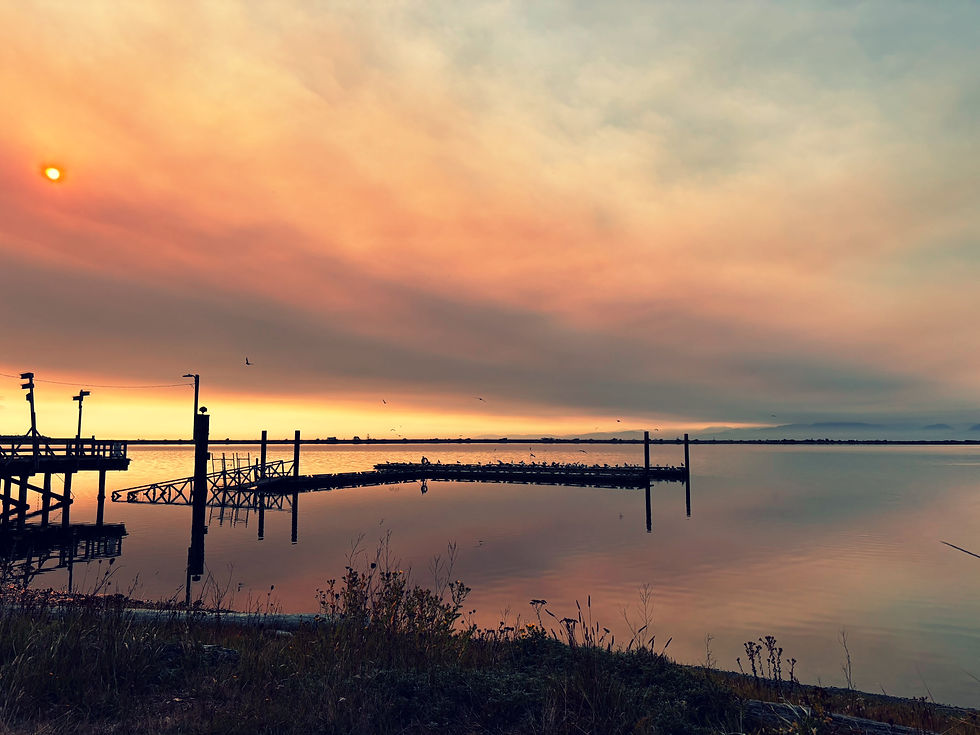
The conditions that morning were surreal. The sun glowed red through the haze of wildfire smoke, and at times it felt like fine ash was drifting through the air. We worked quickly, mindful of both the heat and the air quality. Still, the atmosphere only added to the sense that this work was important, urgent, and bigger than any one of us.

And then came the find we had been waiting for: one European Green Crab. Just one, but catching it matters more than it may seem. One female could unleash hundreds of thousands of offspring, potentially overwhelming the lagoon and destroying the delicate balance of life here. By removing it, we helped protect everything else we’d seen that day—from the sculpins and shrimp to the herons that depend on them.

We also found a couple of Dungeness crabs, which were quickly and carefully released, along with all the other non-invasive species.

What struck me most was the knowledge shared freely among this all-female team. Every person had insights, and I soaked up each detail like a sponge. There are truly entire worlds within worlds beneath the water’s surface, and being part of this work reminded me how much there still is to learn.

As I watched the Kingfisher fishing I smiled, now knowing exactly what they were gulping down—sculpins, gunnels, and all the tiny creatures we’d seen firsthand. That connection between my experience and the broader ecosystem made everything click in a way that felt both grounding and electrifying.


Two days in the lagoon left me buzzing with gratitude. It’s incredible to make a hands-on difference, however small, in protecting our local ecosystems. Even just one invasive crab caught can mean safeguarding an entire habitat. I’m thankful for Judy’s guidance, for the amazing women who joined me, and for the chance to learn and contribute.
This experience has deepened my appreciation for the interconnectedness of life in the lagoon and the fragile balance that holds it all together. I can’t wait to keep learning, keep contributing, and keep sharing these stories of conservation in action.


What an experience! It just proves how much we don't know about nature.
Amazing!
Whole worlds that remain unseen