When the Storm Speaks: Lessons from a Rain-Soaked Day in the Wild - Nov 1, 2025


When I woke up Saturday morning, the sound of pouring rain hit the windows like static—loud, relentless, and chaotic. It matched how my mind had been feeling lately: scattered thoughts, restless energy, and a heaviness I couldn’t shake.
I had planned to spend the day with my macro lens photographing moss and mushrooms—tiny worlds of stillness—but instead, the storm arrived.

At first, I sighed. Then something inside whispered: Go anyway. So I grabbed my 600mm lens, my Aunt, and my adventure cat. If my mind was a storm, maybe it was time to meet nature in hers.
The first bird I saw was a Bald Eagle perched high on a pine tree beside the highway—drenched, feathers slicked down, unmoving against the wind. It wasn’t soaring. It wasn’t hunting. It was simply being.

I pulled over and watched through my lens, rain streaking down the glass. The eagle didn’t fight the storm—it waited through it. That felt like a quiet message from the wild: sometimes power isn’t about flight, it’s about surrender. As I sat in the car, raindrops blurring the viewfinder, I realized my chaos didn’t need fixing—it needed patience.
Did You Know?
Bald Eagles have over 7,000 feathers that keep them insulated, even in harsh weather. During storms, they often perch and wait it out—wings tucked tightly, conserving energy until the winds calm. Even nature’s most powerful raptor knows the value of stillness.
We took a wrong turn and ended up by an old barn, its roof half-collapsed. My Aunt pointed. “What’s that?”


There, on the rooftop, a tiny kestrel fought the wind—fluffing, wobbling, shaking off rain. It looked ridiculous and magnificent all at once. I burst out laughing.
That kestrel was me: restless, uncertain, trying to find balance on life’s slippery roof. Yet it stayed. It danced in the storm. The message was clear—joy can live in chaos if you stop fighting the weather and start moving with it.

Did You Know?
The American Kestrel is North America’s smallest falcon—but don’t let its size fool you. It’s a fierce hunter capable of hovering midair while scanning for prey. That hovering is energy-intensive and nearly impossible in strong winds, so seeing one “dance” in the storm was a rare gift of resilience and adaptability.

AND, of course, I get the classic butt shot. And ain't it cute!

The rain was relentless—pounding, silver curtains blurring the line between sky and earth. Just when I thought the storm couldn’t offer any more surprises, I saw them.
Two Bald Eagles sitting out in a farmer’s field, hunched over something—likely a meal claimed in the storm. Their feathers were drenched, but they didn’t seem to care. They tore into their catch, unbothered by the downpour, the wind, or the chaos around them.

Above them, two more eagles circled the flooded flats, swooping low over flocks of ducks that scattered and regrouped in a panic. The air was alive with motion—rain, wings, wind, and instinct all colliding in a single wild moment.

I stood there, lens steady, heart racing. It was raw, primal, and honest—nature showing both her beauty and her brutality in the same breath. And then I understood the message hidden in the storm: even in chaos, there is purpose. Even in the wildest noise, there is order we may not yet see.
Those four eagles were the embodiment of duality—fierce and focused, yet still at peace with the rain. Watching them, I realized my own stormy thoughts could be like that too: not something to escape, but something to learn from.

Did You Know?
Bald Eagles are opportunistic feeders. While they prefer fish, they’ll often hunt ducks or scavenge in open fields during storms, when other birds are disoriented by wind and rain. Their waterproof feathers and sharp vision allow them to thrive in conditions that ground most species—a powerful reminder that strength isn’t about clear skies, but how you fly through the storm.
Later, near the shoreline, I spotted a Northern Flicker perched miserably in the rain—its feathers plastered, head down. Across the field, a Great Blue Heron stood tall and calm, motionless as the rain streamed down its back.
Did You Know?
Northern Flickers are one of the few woodpeckers that often feed on the ground, searching for ants even in wet weather. Their spotted plumage blends perfectly into rainy forests, keeping them hidden from predators.

Did You Know?
Great Blue Herons can stand motionless for hours waiting for the perfect moment to strike a fish. Their ability to slow down—to wait—is their superpower. In a world that rushes, they remind us that stillness feeds survival.

Two birds. Two ways of weathering. The Flicker reminded me it’s okay to look defeated sometimes. The Heron whispered, Be still and know you’re safe. Nature was holding up a mirror. Sometimes we tremble. Sometimes we trust. Both are sacred parts of the storm.
As we drove away, two more kestrels appeared—a female glowing golden, and a male glaring at me through the lens like a tiny sky warrior. I laughed out loud. The female’s feathers caught what little light was breaking through the clouds, and in that moment, I felt the storm lift—not outside, but within.

The male’s attitude made me smile: Really, bird paparazzi? he seemed to say. Even that humor was healing. Sometimes laughter is the light that cracks through the storm clouds in your mind.

Did You Know?
Male and female kestrels are easy to tell apart—the males have bluish-gray wings while the females are more golden brown. Both share a habit of bobbing their tails when perched—a quirky little rhythm that feels almost like a heartbeat from the sky.

That night, after participating in a saw-whet owl release—a moment that always fills me with reverence—we spotted a family of quails feeding near the road, their tiny shapes illuminated in the car lights.

Did You Know?
California Quail form tight family units called coveys, where adults look after chicks communally. They remind us that community is one of nature’s greatest defenses against life’s storms.
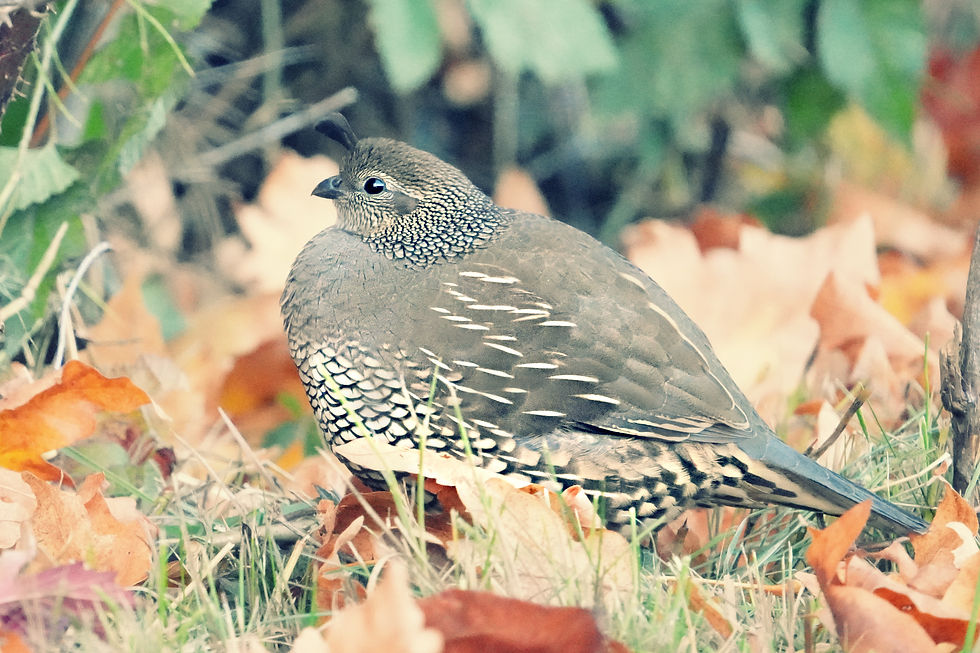
Then, a lone sparrow in the rain caught my eye. I thought she might be injured because all the other birds fled when I came near but she sat there, just looking at me. Like she was just as curious as I was. I was impressed at her bravery.

Then—two Kingfishers chattering and fishing side by side, their laughter echoing through the mist.

Did You Know?
Kingfishers can dive at speeds up to 40 km/h and hit water with precision. Their unique skull structure absorbs impact, allowing them to fish even in rough weather—a perfect metaphor for meeting turbulence with grace.

Later that evening, after the saw-whet owl release, I was still reeling from the day’s incredible encounters. My mind was buzzing, my heart overflowing. While waiting for my pizza—still damp from the rain and barely processing everything I’d just witnessed—I happened to look up.
Six Turkey Vultures were soaring overhead, riding the golden wind currents of a clearing sky. The sun had finally broken through, brilliant and low, casting their dark wings in bronze light. They were fast—almost ghostlike against the brightness—and my camera struggled to keep up.

But then, one of them circled low and looked right at me. That curious, piercing stare froze me in place.
For a second, it felt like time stopped. The vulture’s wings spread wide, catching the light, gliding effortlessly. I laughed out loud and said, “Hot diggity dog!” It wasn’t about getting the perfect shot anymore—it was about being alive in that moment.
It felt like I could reach up and touch them. It was pure, electric connection. It was incredible.

The message was clear: not all beauty looks the way we expect. Sometimes it comes wrapped in shadows, circling high above, reminding us that renewal always follows decay. That the world—even in its darkest corners—is constantly recycling life into life.
Each encounter felt like a small benediction: a whisper from the wild saying, You made it through the day. You made it through the storm.
Every bird that day reflected something I needed to remember:
The Eagles showed me strength in stillness.
The Kestrels taught me to find joy in the unexpected.
The Flicker and Heron revealed the beauty of different kinds of endurance.
The Quails, and Kingfishers whispered that wisdom, community, and joy survive even in chaos.
Almost every photo was taken from the car, hands steady but heart wide open. They’re not perfect—but neither am I. Nature doesn’t ask us to be perfect. She asks us to show up. To listen. To let the storm wash through and leave us clearer than before. So the next time the sky darkens and the rain falls, I’ll remember this: the storm isn’t punishment—it’s purification.
Because even when life feels heavy, the wild keeps whispering: Stay. Watch. Breathe. You’re part of this, too.


Wow! What a special day! And so many birds came to visit you!
Some wonderful pictures--nature was on full display that day!