Where the Birds Gather: Harlequin Ducks and Cormorants at Hornby Island - March 12, 2026
- Jennifer Dowd

- Mar 15
- 8 min read

Day 2 of the Herring Chase
From Buckley Bay, we boarded the small ferry to Denman Island, a quick ten-minute crossing over grey, wind-whipped water. From there we drove across the island to catch the eight-minute ferry to Hornby Island.
I had never been to either place before. That alone made the journey exciting. According to several herring tracking apps and reports online, Denman and Hornby Islands were supposed to be a mecca for herring spawning and the wildlife that follows it. Sea lions. Birds. Feeding frenzies. But when we arrived on Denman Island, we found almost nothing. The shoreline was quiet. The ocean calm. Very little wildlife anywhere we looked. So after exploring for a while, we boarded the ferry again and crossed over to Hornby Island.
And that’s when everything changed.
As we arrived near the ferry dock, I noticed several cormorants flying overhead. I wondered where they were landing.
Then suddenly…BOOM. There they were. Perched along the railings of a derelict pier beside the ferry dock sat what must have been forty or more cormorants. They were stacked three birds high, like a tiered apartment building of seabirds.

It was incredible.

There was a mix of species and colours everywhere I looked. Smaller Pelagic (Common) Cormorants, jet black with flashes of emerald and teal, sat among the larger Double-crested Cormorants. Some birds were brown, likely juveniles. Others were leucistic, with patches of white where pigment was missing.
Most were glossy black.

One Double-crested Cormorant had claimed the very top of a bird box and stood there with his wings wide open like he had just conquered the entire pier. I couldn’t help but imagine him yelling, I’m king of the world!

Look at the patterns in the feathers. INCREDIBLE. And those feet. LOL.

What really surprised me was the sound. At first I thought I was hearing seals barking somewhere in the distance. Then I realized it was the cormorants.
Cormorants don’t exactly have pretty singing voices. Their calls are raspy croaks, grunts, and clacking noises, almost like a group of old wooden doors creaking open all at once. When forty of them start talking at the same time, it sounds like a noisy seabird town meeting where everyone is speaking over each other.
It was loud, strange, and completely mesmerizing.
At one point I caught a cormorant coming in for a landing on the crowded pier, wings stretched wide as it tried to squeeze itself between all the other birds already perched there. For a brief second it actually looked a little worried, like it was thinking, “Where exactly am I supposed to park?” I couldn’t help but laugh watching it carefully navigate the sea of feathers.

In another funny moment, just as I took a photo of a Common Cormorant, a Double-crested Cormorant popped his head up behind him with his wings spread like, Excuse me… I’d like to be in this picture too.

They were clacking and croaking at each other like a room full of people all talking at once. Standing there watching them interact felt like witnessing a seabird town hall meeting.

One cormorant suddenly looked up at the sky, threw his wings open, and squawked at full volume. It had the energy of someone standing in the middle of a room yelling, IS ANYONE LISTENING TO ME?

One cormorant perched on the lower railing kept looking up at the bird above him. I couldn’t help but laugh and imagine what was going through his mind. If I just nibble that foot for a second… would he know it was me?

At one point one cormorant was squawking away at another bird who clearly wasn’t paying any attention. The second bird just stared straight ahead like, If I don’t make eye contact, maybe he’ll stop talking.

Did You Know?
Cormorants often drop straight into the water like cannonballs rather than gently landing. It helps them break the surface quickly so they can dive after fish.

I could have stayed there all day.
Right in the middle of all the chatter stood a Great Blue Heron, looking mildly annoyed, like the one quiet neighbor living next door to a house full of teenagers.

A juvenile Double-crested Cormorant tried to strike up what looked like a conversation with the Great Blue Heron, squawking away beside him. The heron just stared back like a grumpy old man thinking, Please stop talking.

Nearby, one lonely seagull stood apart from the crowd, looking like the new kid in the cafeteria trying to figure out where to sit.

Despite people nearby, the birds were incredibly relaxed. They clearly knew we were there but continued living their lives as if we were simply part of the background.
Watching them was mesmerizing.
Eventually we continued searching for the herring spawn along the shoreline.

At one point we spotted a lone bald eagle perched on a rock, surrounded by hundreds of seagulls scattered across the beach.

He looked like the only adult supervising a very loud daycare.

Then, as I climbed a small bluff to take a photo, something incredible happened. A bald eagle suddenly launched out of a tree right beside me. I hadn’t even noticed him sitting there and completely missed taking a photo of him. I was lost in the moment. The way eagles blend into the trees is astonishing. One moment nothing is there. The next moment a massive set of wings lifts into the sky.
Further along the island we finally found a beach alive with activity. Seagulls filled the shoreline, and floating just offshore were Harlequin Ducks.

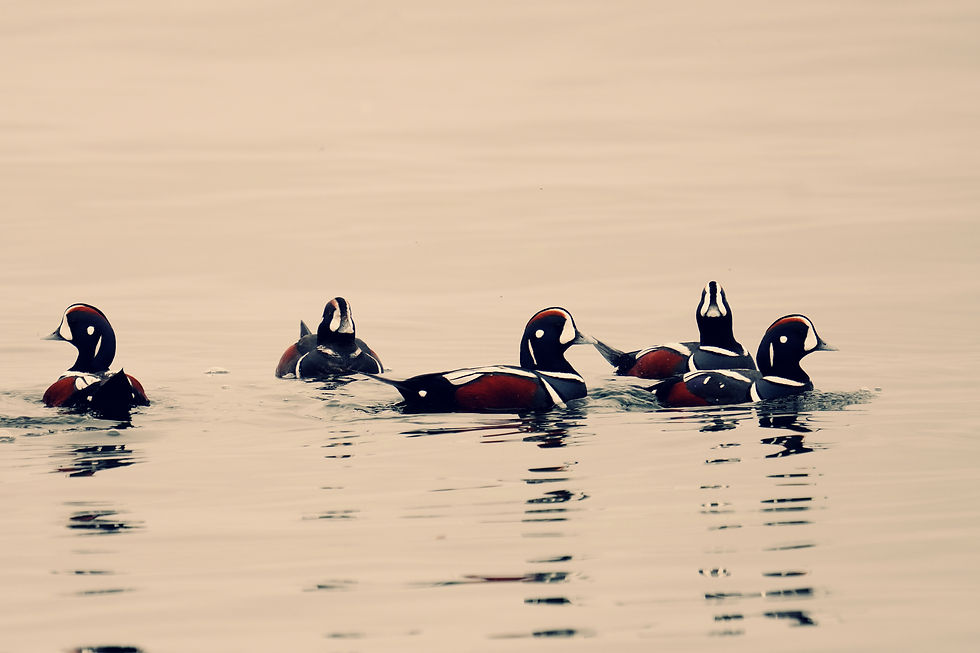
Lots of them.
We have a few harlequins around Victoria, but nothing like this. Some rested on the shoreline while others bobbed gently in the waves, their beautifully patterned feathers standing out against the grey water.

Watching them felt like stumbling into a hidden coastal sanctuary.

Did You Know?
Harlequin Ducks are built for rough coastal waters. They regularly dive in crashing waves to feed on small marine creatures living among rocks.

I can imagine this Male Harlequin Duck saying "What? What are you looking at lady?" Hahaha.

While walking along the beach, I noticed something scattered across the shoreline. Tiny translucent clusters. Roe aka Herring eggs.

Seagulls and harlequin ducks were actively feeding on them, so I kept my distance, but I was fascinated. I had never seen herring eggs before. It’s one thing to see photos online. It’s something completely different to experience it in person.
I gently picked up a few clusters to examine them more closely before carefully placing them back.

Did You Know?
Pacific herring release millions of eggs during spawning, attaching them to seaweed and eelgrass in shallow water. These eggs become one of the most important seasonal food sources along the coast, feeding birds, fish, seals, sea lions, and whales.
As we prepared to leave, I looked up one more time.
High atop a tall pine tree, a bald eagle sat quietly surveying the entire shoreline as if the whole island belonged to him.

Before heading back to the ferry, we took Finnegan, my adventure kitten, for a walk in the forest. Finn absolutely loves the woods. Trotting along beside me on his harness and leash, he explored fallen logs and mossy ground like a tiny wilderness explorer.

Along the trail we noticed interesting mushrooms growing on tree trunks, reminders that even the forest floor has its own hidden ecosystem.

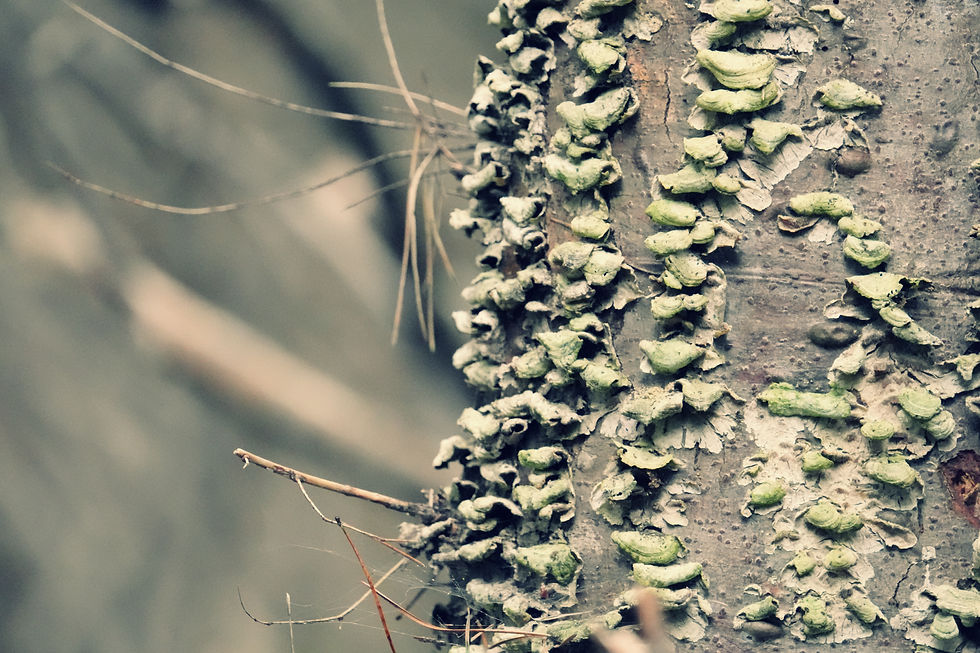
Along the forest trail we noticed patches of pale green lichen clinging to the bark of the trees. These small, leafy growths looked almost like tiny scales layered across the trunk. Lichens are actually a partnership between fungi and algae living together as one organism, quietly thriving in the clean coastal air of the island forest.
As Finnegan and I continued along the forest trail, we suddenly spotted a slug slowly crossing the path in front of us. I have a real soft spot for slugs — they’re surprisingly adorable if you take the time to look closely. With their tiny eye stalks stretching forward and their determined little glide across the forest floor, they always seem so focused on their mission.

Did you know?
Slugs move using a muscular “foot” on the underside of their body and glide along on a layer of mucus, which helps them travel across rough surfaces without hurting themselves.
We paused to watch this little traveler making its way across the trail at its own pace. No rushing, no worrying about how long the journey might take, just slowly and steadily moving forward.
Watching it reminded me that sometimes life is like that too. It doesn’t matter how slowly you move, as long as you keep going, focused on your own path and your own journey.
Along the beach I found something that looked like a strange rubber scrub brush. When I picked it up, I realized it was a gumboot chiton, a tough little marine mollusk that clings to rocks along our coast. Its leathery, rubber-like body was covered in small nodules, making it look almost like a living sponge.
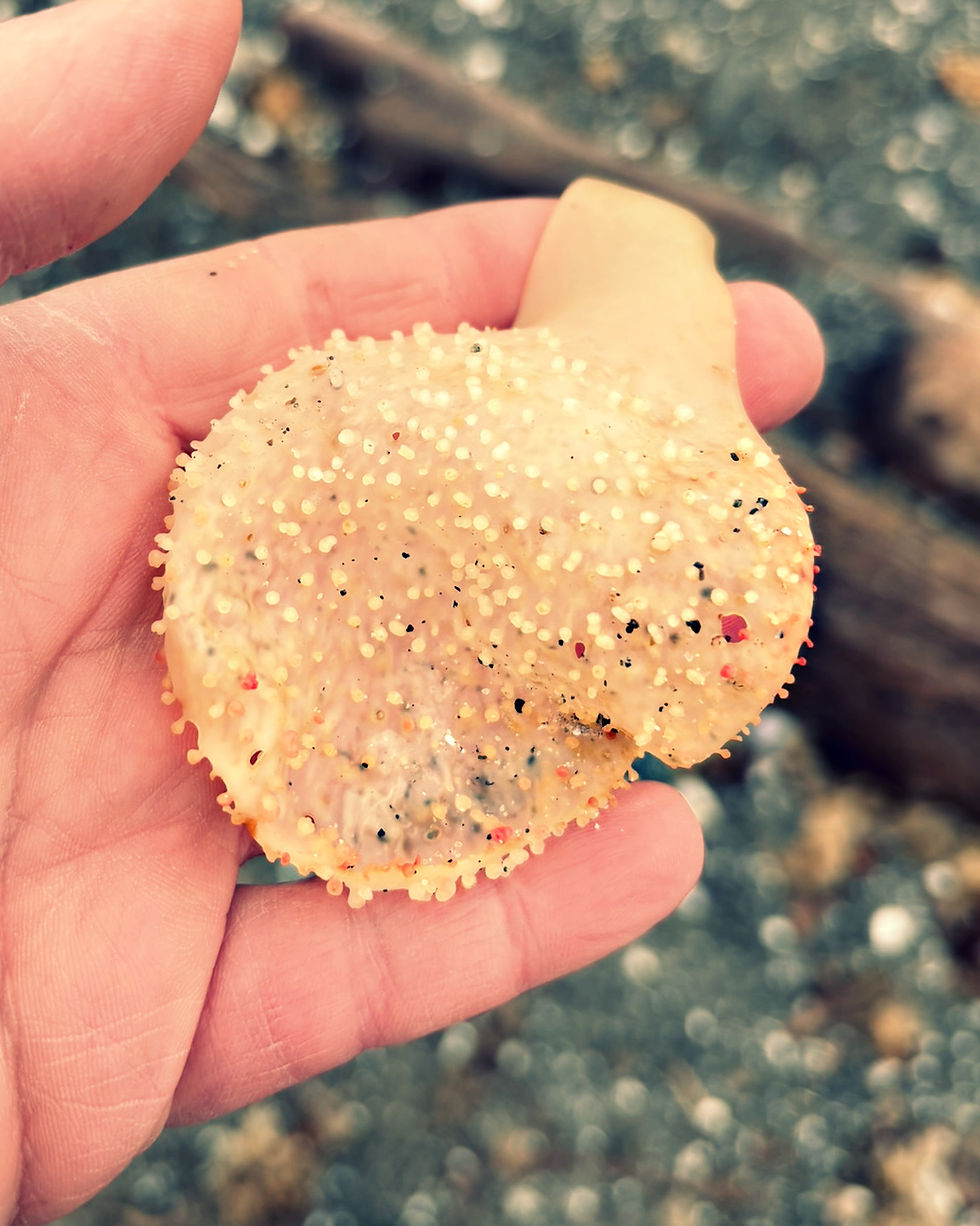
Gumboot chitons are sometimes nicknamed “wandering meatloaf” by marine biologists because of their shape and texture.
As we walked along the beach searching for signs of the herring spawn, the shoreline itself began revealing small pieces of the ocean’s story. Scattered among the sand and stones were oyster shells, clam shells, and tiny sea snails, each one a reminder that the beach is really just the edge of a much larger underwater world.

At one point I found a live oyster lying on the beach, and I gently placed it back in the water where it belonged. Oysters are incredible little creatures, a single oyster can filter up to 50 gallons of seawater a day, quietly helping keep coastal waters clean. Some of the shells were covered in barnacles, those tiny volcano-shaped creatures that permanently glue themselves to rocks and shells. Despite their appearance, barnacles are actually related to crabs and shrimp, and when the tide comes in they open their tiny doors and extend feathery legs to catch food drifting in the water.
Mixed in with the shells were delicate ribbons of Turkish Towel seaweed, pale and lacy after being tossed ashore by waves. When wet, it has a surprisingly soft, almost fabric-like texture — which is exactly how it earned its name.
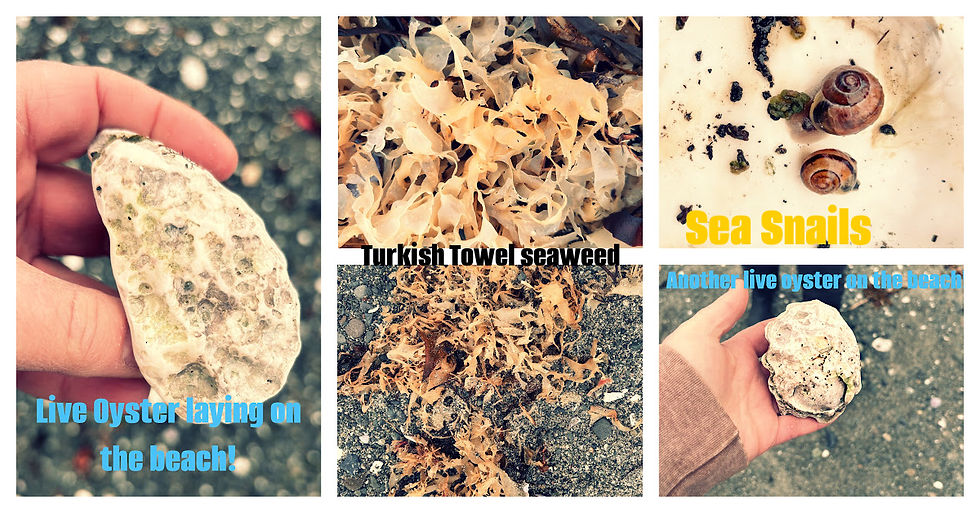
And then there were the sea snails, their small spiral shells like tiny works of art scattered across the sand. These little grazers spend their days slowly moving across rocks underwater, scraping algae with a tongue-like structure called a radula that’s covered in microscopic teeth.
Standing there looking at all these small discoveries, it struck me how much life exists just beneath the surface of the ocean. Every shell, strand of seaweed, and tiny snail was a reminder that the shoreline isn’t just a place where land meets water, it’s a window into an entire ecosystem quietly thriving just offshore.
A lone harbour seal surfaced near the edge of the water, peeking over the waves and watching the shoreline chaos unfold. He looked like he was carefully weighing his options, as if deciding whether to join the action… or just enjoy the show from a safe distance.

Standing there watching all of this wildlife, something else struck me.
The cormorants, packed together on the pier.
The harlequin ducks, calmly floating in cold water.
The seagulls, endlessly calling along the shoreline.
The eagles, quietly observing everything from above.

None of them seemed worried about being judged. None of them appeared concerned with what the others thought. They were simply living their lives. Moment by moment. Focused on what mattered, finding food, staying warm, riding the wind, and watching the tides. Even in harsh weather and in a world increasingly shaped by humans, they carried on with remarkable strength and resilience.
There was something grounding about watching that.
Nature doesn’t rush. Nature doesn’t compare. Nature doesn’t judge. It simply adapts and continues.
Wildlife Wisdom
Cormorant — Community matters.
Harlequin Duck — Strength in rough waters.
Eagle — Perspective changes everything.
Seagull — Adaptability is survival.
Hornby Island didn’t give us the turquoise water of a full herring spawn but it gave us plenty of other wildlife that depending on the herring spawn to live.

Wildlife never ceases to amaze me and neither does nature.

Stay tuned for Day 3 of the herring chase and see if we finally encountered the sea lions in Lantzville.


Still searching...
What an amazing adventure. I live vicariously through you.