A Foggy Morning, a Quiet Mind, and a Gift from the Sea - Dec 13, 2025
- Jennifer Dowd
- Dec 14, 2025
- 7 min read

Yesterday’s adventure began with a simple intention.
On a rare non-rainy Saturday, I headed out early to spend the day practicing my wildlife videography skills. More on that soon (and in future YouTube videos), but for now, this story belongs to the photographs—and to the quiet, powerful moments that unfolded along the shoreline.
I stepped into a fog-covered morning with one very specific goal: Surf Scoters.
If you’ve never seen one, they look like black-and-white, cow-colored ducks with bold, bright orange beaks—almost as if nature decided to have a little fun with their design. They’re ocean birds, often keeping their distance from shore, so every sighting feels like a small miracle. The beach was hushed. The fog was thick. There were barely any cars. It felt like the world had slowed down just enough for me to slip into it unnoticed.

I set up where a group of water birds had gathered, and right away, the action began.
Common Mergansers were fishing—diving beneath the surface and reappearing far from where they disappeared. Watching them is endlessly fascinating.

Did you know?
Common Mergansers are exceptional divers, capable of swimming several meters underwater. Their narrow, serrated bills help them grip slippery fish, and surfacing far from their dive point helps them avoid predators.
As I photographed them, I was reminded that not all progress is visible.
What they taught me: Sometimes the most important work happens beneath the surface, unseen. Just because you can’t see movement doesn’t mean nothing is happening.

Then came the unexpected comedy.
A seagull swooped in and somehow managed to catch a fish—a very big fish. Far too big, really. But that didn’t stop him from trying. I laughed out loud as he wrestled with it, determined beyond reason.
Did you know?
Seagulls are highly intelligent and opportunistic. If there’s even a chance they can succeed, they’ll try—sometimes tackling prey larger than themselves.

What he taught me: Don’t decide something is “too big” for you before you try. Sometimes courage is simply attempting the impossible.
Just as things settled, a harbour seal surfaced. Instant chaos. Birds scattered in every direction, and I couldn’t help but shake my fist playfully and say, “Thanks a lot, buddy!”

Did you know?
Harbour seals are natural fish predators, and birds recognize the disturbance immediately, often clearing the area as soon as a seal appears. It felt like a setback—but it wasn’t.
What he taught me: Disruption isn’t failure. Sometimes it’s just a pause. Wait long enough, and the rhythm always returns.
So I waited.
And while I waited, I looked down.
Along the driftwood and logs beneath my feet, tiny worlds revealed themselves—bird’s nest fungus, shaped like miniature cups, and glowing orange jelly fungus clinging to damp wood.

Did you know? Bird’s nest fungus disperses its spores when raindrops strike the cups, flinging them outward. Orange jelly fungus thrives on decaying wood, helping recycle nutrients back into the ecosystem.

What they taught me: Even in stillness, life is working. Growth doesn’t need attention to be meaningful.
Standing there, overlooking the fog-wrapped ocean, I quietly spoke to my mom.
If you’re with me today, I said, bring the Surf Scoters.

And not long after—the water stirred.
A whole family of Surf Scoters surfaced together.


I raised my 600mm lens, heart pounding, and captured the moment. It was overwhelming in the best way. I almost cried—but instead, I smiled and thanked her.
Did you know? Surf Scoters can stay submerged for up to 30 seconds while diving for shellfish on the ocean floor and often travel in close-knit groups.


What they taught me: Some gifts arrive only when you stop forcing the moment and allow yourself to be present enough to receive them.
The day unfolded beautifully from there.
On the lagoon side, I saw more Hooded Mergansers than I’ve ever seen in one place. I watched them fish, dive, preen, and paddle past me—sometimes gliding by in a neat little row, as if they were moving together on purpose. Their behavior alone was captivating, but what held me just as much was their color.


The females were a beautiful mix of coppery tones and soft browns, accented by bright orange beaks and feet—each one slightly different, each one striking in her own way. The males, by contrast, wore bold patterns of brown, black, and white, with vivid yellow-to-orangey eyes and beaks that somehow pulled everything together.
They were combinations you wouldn’t expect to work—colors and patterns that shouldn’t belong side by side—yet they did. Perfectly. Effortlessly.
Watching them, I was reminded that not everything needs to match to belong. Difference doesn’t create disorder—it creates balance.


Along the shoreline, Dunlins and Black Turnstones worked tirelessly, pecking at plankton along the water’s edge.
Watching a Dunlin along the shoreline is like watching a tiny, feathered burst of urgency. It moved quickly and deliberately, legs a blur, zig-zagging along the water’s edge as if lunch might escape at any second. One moment it was here, the next it was already several steps ahead, probing the sand with rapid precision.

What struck me just as much as its speed were its colors—soft greys and silvers layered so subtly they almost mirrored the shoreline itself. Nothing flashy, nothing wasted, just exactly what it needed to belong where it was.


Did you know?
These shorebirds rely on constant feeding to fuel their long migrations.


What it taught me: There’s a time to be still, and a time to move with purpose. When you trust your instincts and stay present, you don’t overthink—you simply respond.
The Black Turnstones made me laugh. Despite having bright white bellies, they were surprisingly difficult to spot, tucked among the dark rocks as if they had perfected the art of hiding in plain sight. From a distance, they looked like little round chocolate puff balls hopping along the shoreline, blending so seamlessly into their surroundings that my eyes kept sliding right past them.

Their mottled black, brown, and white feathers mirrored the stones beneath their feet, breaking up their shape just enough to make them nearly invisible. It felt intentional—like a quiet confidence in knowing exactly where they belonged.

One Black Turnstone decided it was bath time, and I couldn’t stop smiling. It wiggled and shuffled in the water like a tiny wind-up toy, fluffing its feathers and splashing just enough to make a point. For a moment, all seriousness disappeared—just a small bird having a very important spa moment in the shallows.

What they taught me: Not everything that matters needs to stand out. Sometimes blending in is its own kind of wisdom, and safety comes from knowing when not to be seen.
Nearby, Mallards floated peacefully, heads tucked back, using their bodies as pillows.
Did you know?
Mallards can rest while floating, keeping part of their brain alert for danger.

What they taught me: Rest is not weakness. You’re allowed to pause and still remain aware.
A Great Blue Heron stood motionless in the fog, as if sculpted from it.

Did you know?
Great Blue Herons can remain completely still for long periods before striking with lightning speed.
Then out of the corner of my eye, another Great Blue Heron flew low across the lagoon and landed on the walking path beside the road, as if it were the most normal thing in the world. At times he stood completely motionless, and then—very deliberately—he took a step toward the road.

I laughed and quietly asked him where he thought he was going. Before he could answer, a passerby walked right past without noticing him at all, and the heron exploded into the air, squawking like a prehistoric dinosaur—no doubt voicing his outrage at such a rude interruption to his moment.

What he taught me: Stillness has its own rhythm, and not everyone will notice it. Sometimes presence is quiet—and easily disrupted—but that doesn’t make it any less powerful.
Before leaving that location, a juvenile cormorant surfaced close by, diving repeatedly and making photography a challenge—but an unforgettable one.
Did you know?
Cormorants’ feathers aren’t fully waterproof, allowing them to dive efficiently but requiring time afterward to dry.

What he taught me: Perfection isn’t required to be effective. Sometimes our vulnerabilities allow us to go deeper.
I decided to keep going. With the weather holding—dry, foggy, and calm—I knew I had to take advantage of it. Around here, you never waste a non-rainy day.
My next stop was the coastline. I was hoping to find Greater Yellowlegs, but they were a no-show. Rude.
Instead, I was greeted by Harlequin Ducks.
Have you ever really looked at a Harlequin Duck? The males are an explosion of color—burgundy red, deep navy blue, and stark white, arranged so perfectly they look like velvet. They don’t seem real, like something painted rather than feathered.


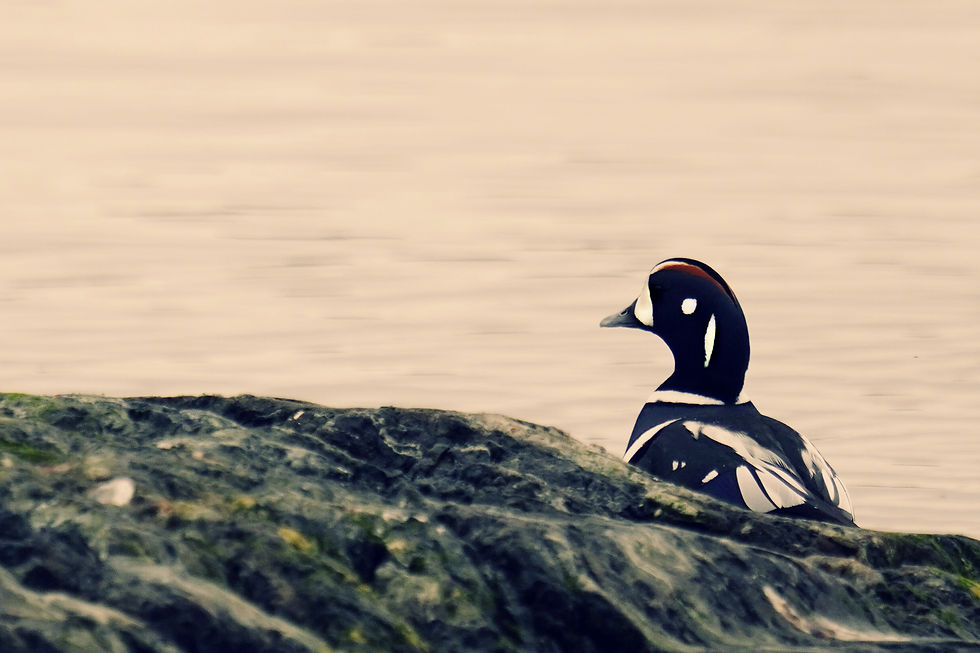
The females may appear more understated at first glance, dressed in black and white, but they are just as captivating. Their intricate patterns and delicate speckling prove that even two tones, when layered with intention, can be absolutely stunning.

This female gave me the look the moment I lifted my camera. Pure attitude. But with beauty like hers, she had to know she was going to be photographed.

What they taught me: Sometimes what you’re hoping for doesn’t show up—and something else arrives instead. Not better. Not worse. Just different. And often, just as beautiful.
Next, I spotted a Black Oystercatcher working the seaweed-covered rocks for his dinner, carefully probing and prying along the shoreline.
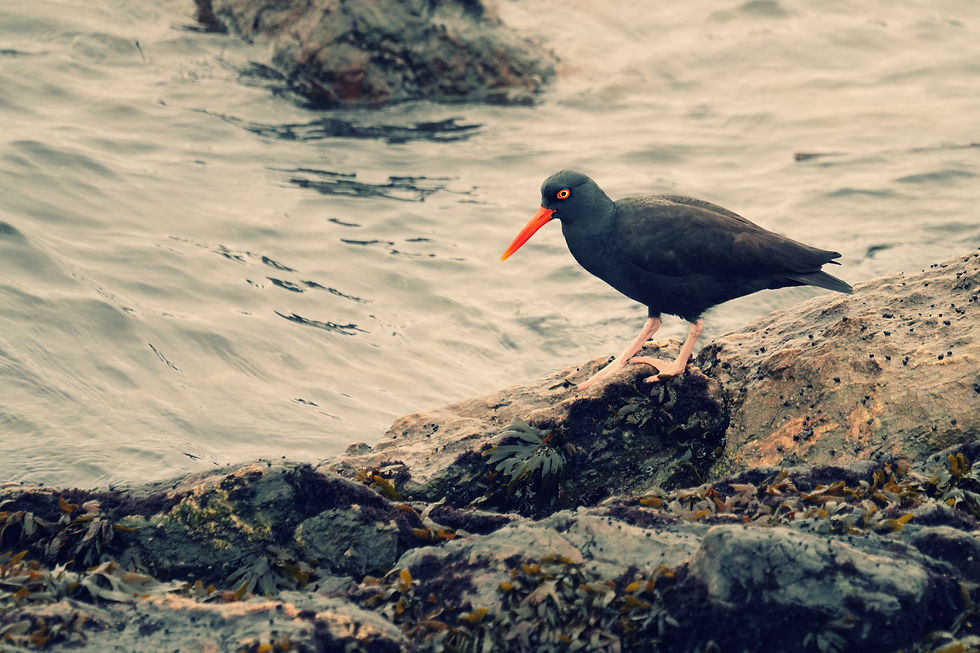
These birds specialize in feeding on shellfish like mussels and limpets that cling to rocks, and the seaweed-covered areas are often rich with hidden food. What can look messy or unremarkable to us is, in reality, a carefully balanced pantry.

That’s why keeping our coastlines clean matters. Discarded fishing line, plastic, and debris don’t just clutter the shore—they disrupt the places wildlife quietly relies on to survive.

What he taught me: Care for the places you pass through. Even small disturbances can ripple outward in ways we don’t immediately see.

And last but not least, a Common Cormorant perched on a small rocky island just offshore. He didn’t stay long—just long enough to pose for a few quiet minutes before slipping back into the water to fish for his lunch. I stood there and watched, unhurried.
At first glance he looked jet black, but when he turned his neck, the light revealed flashes of bright emerald green and deep turquoise—colors so rich they felt almost unreal.


What he taught me: You don’t have to shine all the time. Sometimes it’s enough to simply be, and let your light appear when you’re ready.
Throughout the day, my mom stayed with me—in memory, in spirit, in moments that felt too precise to be coincidence. If I wasn't talking to her, I was talking to myself. I quietly celebrated when I landed a shot. I did a little wiggle and whispered, “Yes, yes, yes.”

I don’t know exactly what it is about nature and wildlife, but being out there makes everything feel okay—even when my mind tries to tell me otherwise. If I push past that inner chatter and go anyway, something shifts. My mind quiets.
Wildlife photography and filming demand presence, patience, and humility. The animals don’t hold still. You have to breathe, wait, and respond. And somewhere in that dance, the meditative magic kicks in. That’s my happy place.


Magic indeed!