A Morning of Conservation and Wildlife Magic at Esquimalt Lagoon - Oct 16, 2025
- Jennifer Dowd
- Oct 16
- 4 min read

This morning, I had the incredible opportunity to participate in my second round of the European Green Crab Trapping Project at Esquimalt Lagoon, part of the Royal Roads University shoreline. The program is run by the Esquimalt Lagoon Stewardship Initiative on behalf of the Department of Fisheries and Oceans Canada, and it plays a crucial role in removing invasive species from a vital migratory bird sanctuary.
These invasive crabs can disrupt delicate ecosystems, so removing them is essential to give native species and migrating birds a thriving, healthy environment. As someone who loves both conservation and wildlife photography, this project is the perfect blend of hands-on environmental work and opportunities to witness nature up close.
I arrived early on this crisp, cool, but sunny morning to make the most of the light and hopefully photograph some of the incredible wildlife I saw the day before when we set the traps. My heart leapt the moment I spotted a Great Blue Heron standing in the exact same spot as yesterday.

And then I spotted another one fishing for it's morning breakfast.

Then, I heard the Kingfisher’s chatter before I saw him perched on a piling, his silhouette cutting a sharp figure against the angled morning sun.


Nearby, a lone Double-crested Cormorant occupied his usual post — and just beyond him, an abandoned dock was lined with ten cormorants basking in the sun.


Sparrows and Finches flitted all around me, curious and bold. I stood still, smiling as they regarded me from the branches. Though the angle of the sun turned everything into silhouettes, I didn’t care. I was surrounded by wildlife, mere steps away from these incredible creatures, soaking in the stillness and beauty of the lagoon.


Did You Know?
The European Green Crab is considered one of the world’s most invasive marine species. Introduced to North America in the 1800s, these small but aggressive crabs outcompete native species for food and habitat, damage eelgrass beds that many fish and birds rely on, and prey on native shellfish.
Just a single female can produce up to 185,000 eggs per year, allowing populations to explode quickly if left unchecked. Removing them helps protect critical coastal ecosystems and supports the migratory birds and marine life that depend on these habitats.

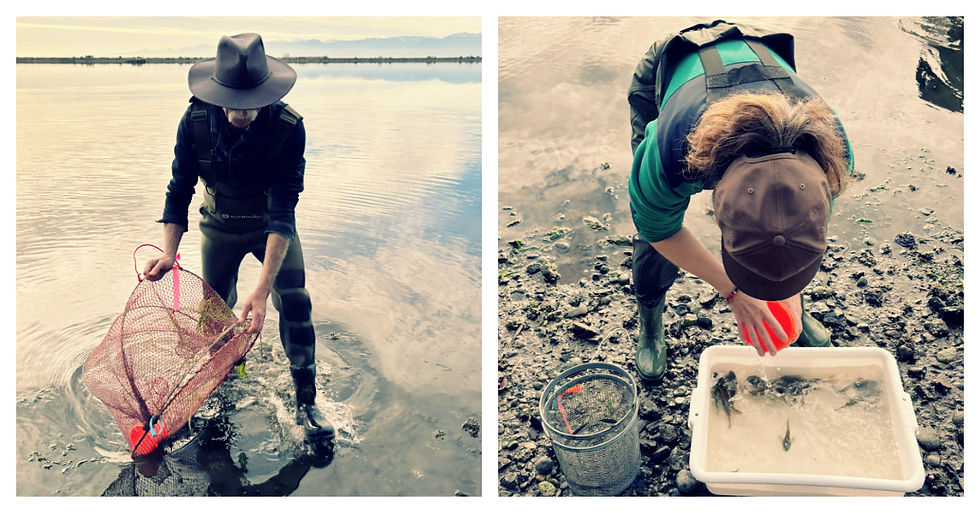
Once the team arrived, we headed to the trap sites to begin documenting our findings. Day 1 is trap setting; Day 2 is trap checking, documentation, and removal of European Green Crabs, while everything else is returned safely to the water.


Today, I was the scribe, while three other team members pulled traps and emptied them into shallow white buckets for sorting. The catch was modest:
Plenty of lear (sculpin) fish
Four male European Green Crabs
A few hairy shore crabs
Some glass shrimp
And one striking yellow-and-silver striped fish called a Shiner Perch (I think); Shiner perch are native to the Pacific Northwest and are an important part of the coastal food web, feeding on small invertebrates and providing prey for larger fish, birds, and marine mammals. They’re often caught in traps during crab surveys because they inhabit the same shallow waters.


The team worked like a well-oiled machine, finishing the round in no time. Overhead, kingfishers chattered as they flew by, and herons glided gracefully above the lagoon. With still, glass-like water, mountains rising in the distance, and clouds drifting across a blue sky, it was one of those perfect West Coast mornings — not too hot, not too cold, just right. This view is incredible, right?

I’m incredibly grateful to Anne and John, the kind husband-and-wife team who shared their experience, and to Judy, our fearless leader who patiently walked me through my scribe duties.

As we wrapped up for the morning and started heading back to the car, we spotted a dead seaweed crab washed up on the beach. Its shell had been picked clean, most likely by seagulls or other shorebirds taking advantage of the easy meal. I found it absolutely fascinating — it was huge, and I had never seen a crab that big in person before.

Seaweed crabs are a native species commonly found along the Pacific Coast. They’re easily recognized by their long, spindly legs and a rough, algae-covered carapace that helps them camouflage in kelp and eelgrass beds. Unlike the invasive European Green Crab, seaweed crabs are an important part of the local ecosystem, often feeding on algae and providing food for birds, fish, and other marine animals.
Seeing such a large individual, even in death, was a striking reminder of how interconnected coastal life is — every creature, alive or not, plays a role in sustaining the shoreline ecosystem.

Being part of this project fills me with purpose. I’ve been searching for a conservation initiative where I can truly get my hands dirty, and this is it. There’s something deeply rewarding about working alongside like-minded people who care for wildlife and ecosystems as passionately as I do.
I’ve already learned so much in just two sessions, and I can see myself being involved in this project for the long run. It feels good — deeply, soulfully good — to contribute to the protection of a place that so many migratory birds depend on.


I very much appreciate you sharing this adventure with us. We are learning,along with you.
It was a fabulous day and a sad day. It was a beautiful scene but we did catch 4 large European green crab. Good that they were removed but sad that they are there. Your blog is wonderful. So happy to meet you and work with you.
Another perspective on wildlife