Seeing Wildlife Differently: Observing Nature in Black and White - March 16, 2026
- Jennifer Dowd

- Mar 17
- 5 min read

As a wildlife photographer, I rarely convert my photos to black and white.
For me, wildlife photography has always been about colour — the iridescent greens of a hummingbird, the soft browns of a squirrel’s fur, the dramatic contrast of a black oystercatcher against the shoreline. Colour is part of the magic of nature.
But recently, I decided to try something different.
Instead of focusing on colour, I began observing wildlife and nature moments as if the world were in black and white.

At first, it felt strange. Removing colour felt like removing part of the experience. But something unexpected happened. Without colour competing for attention, I began to notice patterns, shapes, textures, and movement in a completely new way. Black and white changed how I saw. And in doing so, it changed how I photograph.
Colour can be powerful, but it can also be distracting.

When we remove colour, our eyes naturally shift to other elements:
• contrast
• texture
• shape
• light and shadow
• repeating patterns
These are the foundations of strong photography. Black and white forces us to look more carefully at what we are seeing. Instead of reacting to colour, we begin to observe the structure of the moment.

Watching a painted turtle resting on a log in black-and-white observation revealed something I had never paid attention to before.

Without the greens and browns of the shell and water, the turtle became a study of texture and shape.
The hard plates of the shell formed geometric patterns.
The log beneath it was rough and weathered.
The water around it created smooth, soft reflections.
The entire scene was a composition of contrasting textures.
It reminded me that wildlife photography is often about placing animals within the patterns of their environment.
Looking closely at a bald eagle in black and white is an entirely different experience than seeing one in colour.
Normally, the stark contrast of the eagle’s white head against its dark body is what first captures attention. But when colour is removed and the image becomes black and white, the focus shifts to something deeper structure, texture, and intensity.
In the close-up portrait, the first thing that stood out to me was the layering of the feathers. Each feather along the eagle’s neck created a delicate pattern of light and shadow, almost like overlapping scales. The softness of those feathers contrasted beautifully with the powerful shape of the bird’s hooked beak.

The beak itself became a study in form, smooth, curved, and sharply defined against the surrounding feathers.
But the most striking element was the eye. Without colour pulling attention away, the eagle’s eye became the center of the entire moment. The dark pupil and the surrounding textures around the brow gave the bird an intense, almost ancient expression. It felt less like looking at a bird and more like looking into the presence of a powerful wild creature.
Observing this portrait in black and white revealed details I might otherwise have missed the fine feather textures, the dramatic contrast between light and shadow, and the incredible precision of the eagle’s features.
It reminded me that sometimes the most powerful wildlife moments aren’t about colour at all. They’re about the character written in every feather, every curve, and every glance.
Normally, the beautiful yellow legs of this shorebird immediately draw the eye. But imagining the scene in black and white shifted my focus.

Instead, I noticed the long vertical lines of its legs, the elegant curve of its neck, and the ripples spreading outward through the water. The reflection created a mirrored shape that almost doubled the bird. The moment became about symmetry and balance, not colour.
One of the most fascinating subjects to observe this way was sea kelp washed up along the shoreline. Without colour, the kelp became a series of twisting lines and flowing shapes. It looked almost like calligraphy drawn across the sand.


Nature was writing patterns on the beach. This reminded me that even simple subjects can create compelling visual stories when we focus on form and movement.
When I imagined this scene in black and white, the bird itself became less about its striking markings and more about motion. The water parted around the merganser as it glided forward, creating a delicate wake. The ripples formed soft circular patterns that followed the bird.

It became a moment about movement through space, not colour.
European starlings are often admired for their iridescent feathers. But in black and white, their beauty appeared in a completely different way. The feathers became a tapestry of tiny light and dark spots, almost like a star-filled sky. The bird’s posture on the branch formed a simple silhouette against the background.
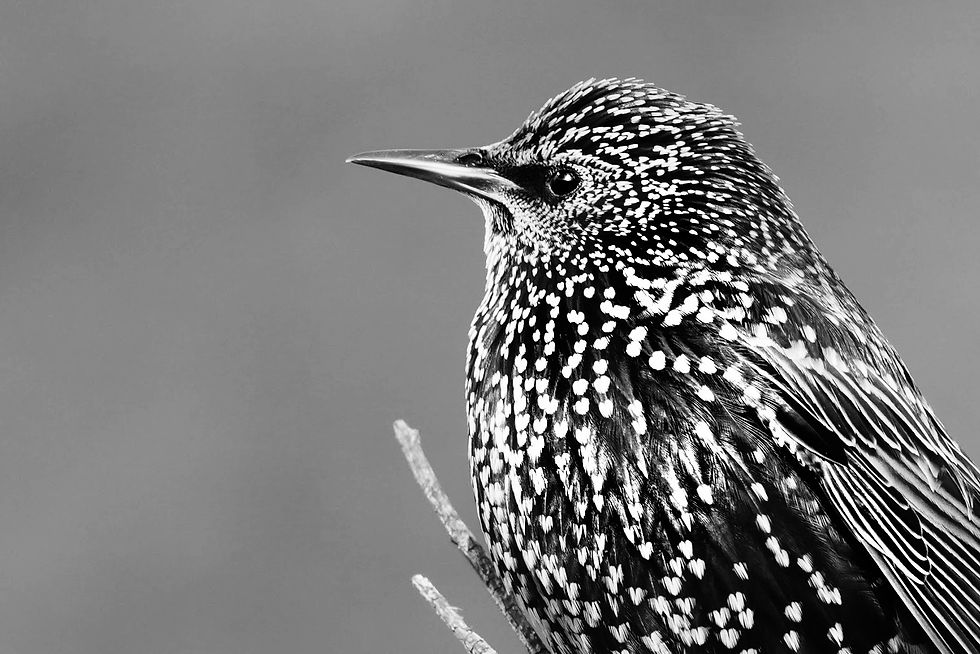
It was a lesson in pattern and contrast.
Photographing a waterfall in black and white completely changes how you see the scene.
Normally, when we look at waterfalls in colour, our attention is drawn to the surrounding greens of moss, the browns of tree trunks, or the blue tones in the water. But when colour disappears, the waterfall itself becomes the focus. What emerges is movement and contrast.
The falling water transforms into soft ribbons of white flowing through darker rock and shadow. Each stream of water creates its own pattern as it moves downward, twisting and separating before joining again at the base. Instead of seeing water, I began to notice textures.

The smooth silk-like motion of the falling water contrasted against the rough surfaces of the rocks. Mist gathered at the bottom of the falls, softening the scene and creating a dreamlike effect.
Even the surrounding landscape took on a different role. Moss-covered rocks and branches became darker frames that guided the eye toward the flowing water.
In black and white, the waterfall felt less like a colourful landscape and more like a study of light, motion, and time.
Watching it this way reminded me that waterfalls are never still. They are constantly reshaping themselves, moment by moment. And sometimes, removing colour allows us to see that motion more clearly.
This simple exercise changed how I observe wildlife.
Even when I returned to photographing in colour, I found myself noticing:
• stronger compositions
• more interesting textures
• better use of light and shadow
• natural patterns in landscapes and animals
Black and white observation trains your eye to slow down and truly see what is in front of you.

If you want to try this yourself, the next time you’re outside observing wildlife or nature:
Pause before taking the photo.
Imagine the scene without colour.
Look for patterns, shapes, and textures.
Notice how light falls across the subject.
Then take the photograph.
You may be surprised by what you start to see.

Seeing the Wild World Differently
Nature is filled with colour, and that will always be part of its beauty.

But sometimes, removing colour helps us notice what has been there all along.
The patterns of feathers.
The textures of bark and shell.
The shapes of animals moving through their world.
Black and white doesn't remove the magic of wildlife.
In many ways, it reveals it.


Well said, calling attention to things that are easily seen but often missed.
Even in black and white,your pictures are very colourful. Way to go.