The Fish of Bee Creek Have Opinions - Aug 29, 2026


On Saturday, I spent part of the day doing fish monitoring in Bee Creek, an urban stream that, at first glance, could probably be mistaken for just another little creek running through a developed area. But Bee Creek is much more than that. It is an important ecosystem, a nursery for young trout, and, judging by the fish we met, also home to some very colourful personalities.
Across our monitoring sites, we found 14 fish in total. Fourteen tiny reminders that this creek is alive and doing exactly what a healthy stream should be doing.
And these fish were beautiful. I mean, really beautiful. Brilliant silver, orangey-peach, red, yellow, spots, stripes and all sorts of patterns that looked like someone had decided trout needed a much better wardrobe. I don’t think I had ever really stopped to appreciate just how colourful juvenile trout can be until I saw them up close.
They were also not particularly impressed with us.

As we carefully measured and recorded them, several seemed to be giving us some fairly serious side-eye. Which, to be fair, was understandable. Imagine going about your Saturday morning, minding your own business, and suddenly being scooped up by a group of very enthusiastic humans who want to measure you, admire your colouring and discuss you at length.
I’m pretty sure at least one of them was thinking, “Are we done here?”

But those little fish tell a much bigger story.
Streams like Bee Creek can serve as incredibly important nursery habitat for trout, including steelhead and cutthroat. Fish are born in freshwater streams like this one, where they spend the early part of their lives feeding, growing and hiding among rocks, plants, woody debris and deeper pools. Some may stay in freshwater for one to three years before eventually making their way downstream toward the ocean.
For migratory fish such as steelhead, that journey can eventually come full circle. They grow and mature in the ocean and then return to freshwater to spawn, beginning the whole cycle again. Coastal cutthroat can have slightly different life histories, with some moving between freshwater, estuaries and salt water, while others remain primarily in freshwater.
Which means this unassuming little creek running through an urban area is not just “a creek.”
It can be a birthplace. A nursery. A hiding place. A feeding ground. A highway.
And that is pretty incredible when you think about it.
One of my favourite parts of the day, though, was watching everyone react when we found fish. There is something very uplifting about being surrounded by people who are genuinely excited to see a tiny trout in a trap.

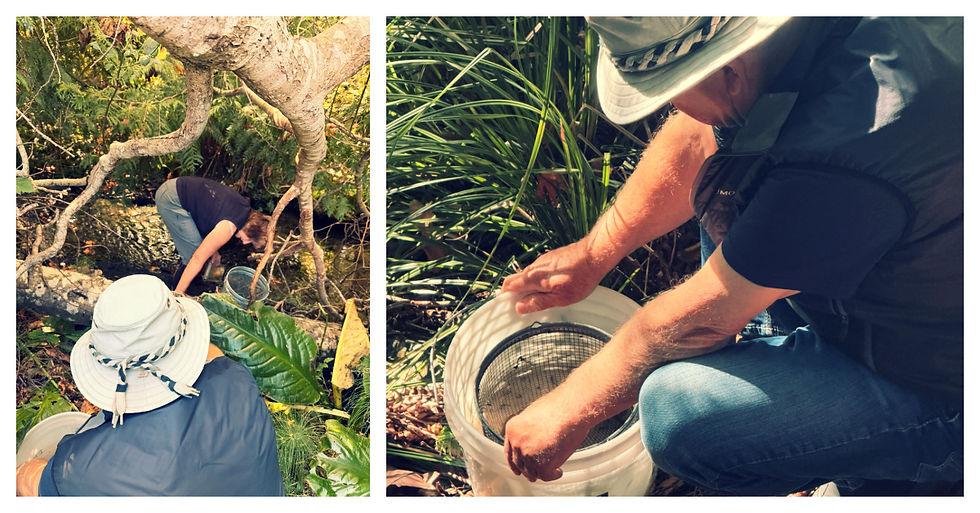
People gathered around to look at the colours, help with measurements, record information and make sure every fish was handled carefully before being returned to the creek. There was real excitement every time we discovered another one.
And nobody had to be there.
These people chose to spend part of their Saturday standing beside a creek measuring tiny fish because they care about nature and about the place where they live.
That matters.
Community stewardship can sometimes sound like a big, formal concept, but often it looks much simpler than that. It looks like people showing up. Carrying equipment. Taking measurements. Recording data. Getting muddy. Asking questions. Celebrating fourteen little fish.
It is people deciding that the natural spaces woven through their neighbourhoods are worth paying attention to.
Because nature does not stop where the city begins.
Wildlife does not look at a road, a parking lot or a row of houses and decide that humans have claimed the area and it should probably move somewhere else.
Nature keeps trying to live alongside us.
And Bee Creek is a good example of what can happen when we make room for it.

We do not always have to force nature to work around us. We can protect streamside vegetation, keep waterways clean, restore habitat and make decisions that allow wildlife to continue using the places it has depended on for generations.
We can live with nature instead of constantly asking nature to get out of our way.
Fourteen fish might not sound like a huge number.
But when you are standing beside an urban creek looking at a tiny trout flashing silver, peach, red and yellow while it gives you an extremely judgemental look from the measuring board, fourteen fish feels pretty exciting.
Because those fish mean something is working.
The creek is still supporting life.
And there are people in the community making sure it has the chance to keep doing so.
Bonus wildlife sighting:
On the way to another monitoring site, we spotted a garter snake stretched out in the leaves, soaking up the sun like he had absolutely nowhere else to be. He was incredible. Instead of immediately disappearing, he seemed more curious than afraid, watching us while we admired him from a respectful distance. I managed to get exactly one photo before he apparently decided the meet-and-greet was over.
See yah never!

And just like that, he vanished back into the leaves.
It was another little reminder that Bee Creek isn’t only about the fish. There is an entire community of wildlife tucked into and around this urban ecosystem, sometimes all it takes is slowing down long enough to notice it.


The importance of small deeds.